
South Plainfield Previous Residents by Era
A useful South Plainfield address history moves through time instead of expecting one database to name every past household. Begin with the current parcel, then work backward to the newest deed and earlier transfers. Directories, newspapers, census schedules, maps, and probate records can add people and dates after a transfer is verified. The coverage below shows why every South Plainfield claim about previous residents needs its own source and time label.
| Evidence source | Period represented | Where to use it | What it can establish |
|---|---|---|---|
| Middlesex online deed index | Current page says 1929 onward for deeds; county notice describes digitized deeds back to 1923 | County Clerk public search | Parties, instrument, date, book/page, legal description, and status |
| Earlier deed books and microfilm | County deeds through 1900 described by the Archives; Clerk holdings reach much earlier | County Clerk, State Archives, and verified research routes | Transfers, maps, names, and legal land descriptions |
| Plainfield city directories | 1868 to 1982 | Plainfield Public Library Local History | Dated name and address entries, subject to geographic coverage |
| South Plainfield newspapers | 1931 to 2004 listed | Digifind-It archive | Notices, obituaries, civic activity, and address clues |
| State and federal census | NJ state census 1855 to 1915; federal schedules under the 72-year rule | State Archives and authorized research collections | Household structure and residence context |
| Permit, probate, and obituary files | File-specific or collection-specific | Borough, Middlesex Surrogate, and library | Project, estate, death, executor, or family leads |
Start with the most recent confirmed South Plainfield record, then choose the next older source. A title transfer identifies a legal connection, while a directory or census can add a household context. Neither should be extended into an unverified claim about an intervening year.
South Plainfield Parcel Before a Name
A South Plainfield address must be anchored before searching names. Use the NJGIN parcel and Property Explorer route to locate the address by county, municipality, block, and lot. Record the exact situs address, current owner spelling where public, parcel ID, block, lot, and any mailing address. The state property display can also show annual values, classification, prior-year taxes, and exemption flags, but it is a dated assessment snapshot and may lag a recorded South Plainfield transfer.
A South Plainfield mailing address is not proof that a person lived at the parcel. It may be another property, post-office box, trust, attorney, or estate address. Daniel’s Law may also redact an owner name. When a field is redacted, leave it redacted in the notes and continue with the legal description, block/lot, and recorded-instrument path.
For South Plainfield previous residents, the parcel is the stable anchor. The address can change form, a tract can be subdivided, and a household can appear under a former name. A block/lot or legal description makes it possible to test whether the older record concerns the same land.
South Plainfield Previous Residents Deed Trail
The first backward step for a South Plainfield parcel is through the Middlesex grantor-grantee and parcel index. A grantor is the party transferring an interest. A grantee is the party receiving it. Search the current owner as grantee, inspect the resulting purchase instrument, and then search the seller as an earlier grantee. Keep the legal description beside the name at every step, because trusts, estates, corporations, marital names, and subdivisions can interrupt an apparent chain.
- Save the current South Plainfield parcel identifiers and assessment year from the state or local property route.
- Search the current owner as grantee in South Plainfield, using the date, lot/block, parcel, book/page, or instrument path if needed.
- Capture the purchase deed’s grantor, recording date, legal description, instrument number, and book/page.
- Search that grantor as a grantee in an earlier period, then check that the legal description still identifies the same land.
- Repeat only while the parcel relationship remains supported. When the online index ends, mark the next step as an office or microfilm task.
The index can search by party, town, date, instrument, book/page, lot/block, map number, district/map/submap/parcel, and parcel ID. It also marks records that are not verified. A name row is a lead, so retain the status and request the detail or official copy if the image is incomplete.
- Grantor and grantee
- The party conveying an interest and the party receiving it, as named in a recorded instrument.
- Chain of title
- The documented sequence of transfers for the same parcel, checked through legal descriptions rather than name alone.
- Legal description
- The deed’s land description, often more durable than a street address when a tract is subdivided or an old record lacks a modern number.
- Criss-cross directory
- An address-arranged directory that can place a dated name at an address when its geographic coverage supports the match.
- Enumeration district
- The area used to organize a census. It helps locate the right schedule but is not itself proof of a particular address.
Middlesex Deed Index Verification Gap
The South Plainfield deed cutoff needs special care. The current County Records Search text says deeds begin January 1, 1929. A 2022 county digitization announcement says public deeds were searchable back to 1923, while the Clerk reports deeds and mortgages on file from 1683. Those statements do not establish a continuous online run for every year between 1923 and 1929.
Label that South Plainfield period as a verification gap. Save the result page, note the coverage language shown on the search date, and ask the Registry which book, index, image, or Public Search Room route applies to the instrument. Do not write a missing online row as proof that no South Plainfield transfer occurred. The County Clerk’s physical record route is at 75 Bayard Street, fourth floor, New Brunswick, with public hours listed as Monday through Friday, 8:30 a.m. to 4:10 p.m., and the county asks visitors to arrive by 4:00.
Older South Plainfield deeds may require the Public Search Room. County deeds through 1900 are also described by the State Archives as available on microfilm. The result is a three-part trail: online index checked, office or microfilm consulted, and unresolved years kept visible.
South Plainfield Older Deed Routes
When the South Plainfield web index does not reach the needed time, use the custodian that holds the record. The Middlesex County Clerk is the office route for recorded instruments and its public search room. For earlier South Plainfield county deeds, state census, historic vital, probate, court, military, and newspaper material, use the New Jersey State Archives research center and its stated appointment, index, microfilm, and mail-research options.
Ask before traveling whether the specific South Plainfield book, microfilm roll, or file is available and whether images can be viewed, copied, or certified. Give the book/page, instrument number, party spelling, parcel identifier, municipality, and approximate date. That narrow request is more useful than asking the office to find every former household at an address.
The New Jersey State Archives research center provides the official starting point for earlier South Plainfield and Middlesex collections.
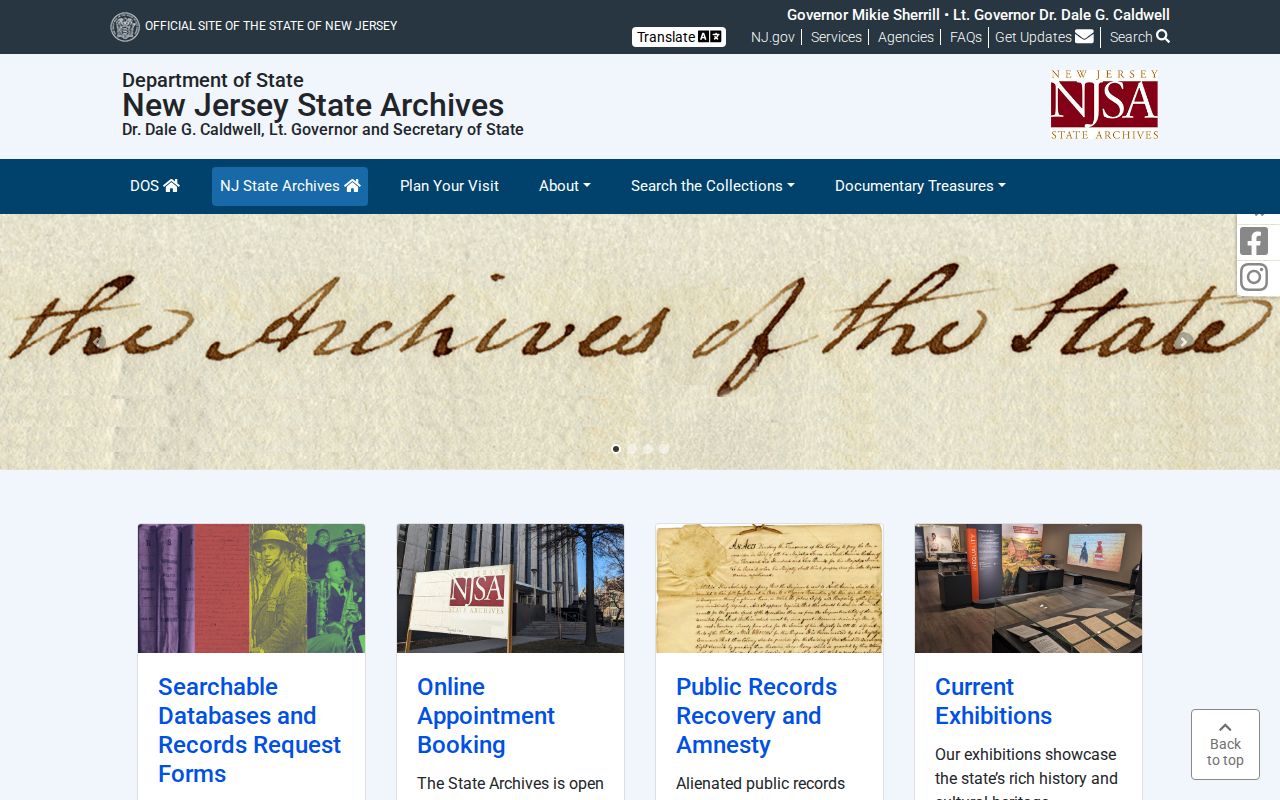
The archive route is especially important when the online deed result ends before the address history does.
South Plainfield Previous Residents in Directories
For people who lived at a South Plainfield address, move from a verified transfer to dated household evidence. The Plainfield Public Library Local History room holds Plainfield City Directories from 1868 to 1982, but the inspected material does not prove a complete South Plainfield-specific run. Confirm the directory’s geographic coverage for the South Plainfield address before relying on an entry. The library also maintains local history, obituary, newspaper, surname, cemetery, funeral-home, and house-history materials with staff assistance.
South Plainfield’s Digifind-It archive adds searchable documents, maps, newspapers, and scrapbooks. It lists The Chronicle, South Plainfield Observer, The Reporter, and The Review for 1931 to 2004, plus scrapbooks and clippings for 1951 to 2009. Search a verified surname, the street, an organization, and the historic place label, then inspect the page image because OCR can misread names and addresses.
The regional collection details belong in the South Plainfield Directory Book. Here, use a directory entry as a dated checkpoint in the address trail, not as a permanent occupancy finding.
South Plainfield Historic Address Names
The South Plainfield historic jurisdiction is a real search problem. Before the 1926 borough incorporation, the modern area was part of Piscataway Township and included the names New Brooklyn and Samptown. Old deeds, maps, newspapers, and directory references can therefore appear under Piscataway, New Brooklyn, Samptown, Brooklyn, Middlesex County, or a tract description rather than South Plainfield.
Search each name variant with the street, surname, and legal description. Keep the exact older wording, a modern normalized address, the nearest cross street, and block/lot together in the research notes. The local history material references 1850, 1859, and 1861 maps with houses and owners, but no verified local South Plainfield Sanborn run was located. A general map catalog is only a place to check, not proof that a local sheet exists.
Note: A map alignment or a similar road name is a probable bridge until a deed, directory, or other dated record verifies it.
South Plainfield Households With Census
Pair a directory year with the nearest available census period only after the South Plainfield parcel or address connection is supported. A directory can provide a name and address form. A federal census schedule, released under the 72-year rule, can provide South Plainfield household context. New Jersey state census records from 1855 to 1915 add earlier context through State Archives routes. Neither source turns a close date into proof that the household stayed at the address through the intervening years.
- Record the directory title, year, page, address form, and all abbreviations exactly as printed.
- Use the verified historic place name and census enumeration area to find the appropriate schedule.
- Compare surname, first initials, age, family relationship, location, and date with the deed or directory evidence.
- Check a nonconsecutive directory year, newspaper image, or probate clue before extending the household timeline.
Obituaries and probate records provide useful endpoints. The Plainfield Local History files include an obituary index for roughly the mid-1920s through the mid-1980s. The Middlesex Surrogate search accepts name, docket, case type, birth date, death date, and town fields. A result may lead to an estate file, executor, or dated family connection, subject to the office’s access and copy procedures.
South Plainfield Address File Fallback
Building permits, zoning files, property-maintenance material, and related South Plainfield municipal records can date a physical change or identify an applicant or file number. No public South Plainfield address-search permit or code-case index was located. Use the borough forms and permit page to make a narrow request by South Plainfield address, block/lot, file number, record type, and date range.
Ask separately for applications, approvals, inspection results, violations, or certificates. Under OPRA, the agency responds to identifiable existing records and does not have to create a house-history report. A permit helps date work and documents a file-level connection; it does not, by itself, identify the people who lived there.
South Plainfield Previous Residents Limits
South Plainfield previous residents research is strongest for family history, property history, estate questions, and local history. It is not a way to identify every person connected with an address. A deed establishes a title transfer, not occupancy. A directory is a dated lead. A census schedule is a dated household snapshot. A permit identifies a South Plainfield record connection. Preserve those limits and do not fill a missing year from a nearby address, a similar surname, or an unsupported map match.
Protected South Plainfield records and people remain protected. New Jersey’s Address Confidentiality Program can substitute an address, and Daniel’s Law can suppress protected home information. Respect those results. The South Plainfield research route ends when the public evidence ends, unless a legitimate, specific request can be made to the custodian.
Lawful use. South Plainfield house-history research is for personal, family, estate, and historical questions. Never use a record trail to harass, monitor, or threaten a living person.